
🚗 NDIS Transport Funding: What clinicians need to know (without the confusion)
Transport funding under the NDIS can feel like one of the murkiest parts of the planning puzzle—and you’re not alone if you’ve ever wondered how exactly to justify it in a functional capacity assessment (FCA).
Here’s the good news: once you understand what transport funding actually covers, and how to speak to it in your report, it becomes much simpler to recommend it confidently and appropriately. Let’s walk through what you need to know—and how Scripto can support you along the way.
What does NDIS transport funding apply to?
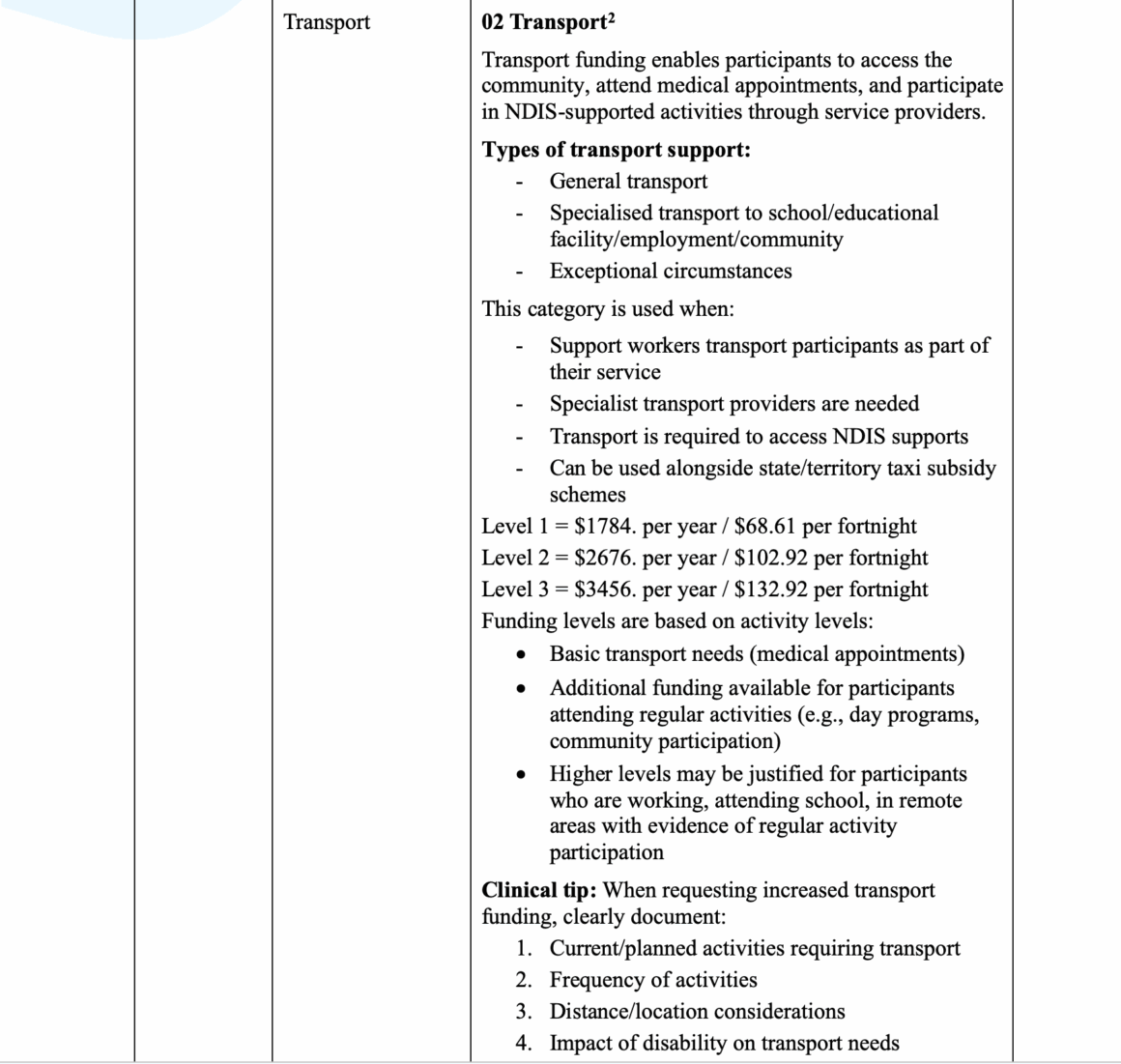
Transport funding is intended to support a participant to access their community and necessary services—not just medical appointments. It can cover things like:
- Travel to therapy appointments (OT, physio, speech, etc.)
- Access to community or social activities
- Attending TAFE, university, or training programs
- Getting to work or volunteering
- Independent living skill-building programs
- Travel to day programs or support coordination sessions
The key is function. If the participant has a disability-related functional limitation that affects their ability to travel independently, that’s when transport support may be considered.
🛠 How to justify transport in your NDIS clinical reports
NDIS planners need a clear link between the participant’s functional capacity, goals, and need for transport. Here’s what to include in your clinical notes or Scripto inputs:
✅ What prevents the person from using public transport independently?
Is it sensory challenges, difficulty with way-finding, emotional regulation, physical access, or cognitive barriers?
✅ Does the participant currently rely on family or paid supports to get around?
Make this clear. Describe who assists and what that looks like. Describe the frequency of appointments and distance/location considerations.
✅ What goals would transport funding help achieve?
Examples: “Increase access to the local community,” “Attend work readiness training,” “Improve social participation.”
✅ What strategies have been trialled?
You can also mention if travel training has been explored but isn’t yet effective.
💡 Pro Tip: Use the “Mobility and Community Access” section in Scripto to include these insights. If you’re not sure how to phrase it, we’ve included examples directly in the prompts to help.
🧾 Quick note on funding levels:
NDIS participants may receive one of three transport funding levels, depending on their circumstances:
- Level 1: For participants not working or studying but needing transport for community participation.
- Level 2: For participants working/volunteering less than 15 hours/week or attending day programs.
- Level 3: For participants working/volunteering/studying more than 15 hours/week or in living in remote areas.
*As clinicians, we don’t need to recommend the level—just the need and justification. The planner will allocate the appropriate tier. Transport funding can be used in conjunction with state/territory taxi subsidy schemes.
🎯 Final tip: Keep it functional, not aspirational – NDIS funding is tied to function. Rather than saying a participant wants to go places independently, describe the functional barriers that prevent this, and how transport supports will bridge that gap.
Download the free NDIS Support Category Table for more information: https://www.scriptoai.com.au/free-resources
by Sophie Barrett